

So you’ve accepted an offer on your home. Your solicitor is on the case. You’ve mentally started packing. Then the phone rings – someone three steps up the chain has pulled out. Your sale is dead. You’re back to square one, and you’ve just wasted three months and several hundred pounds in fees you’ll never see again.
This is not an unusual case. It happens to nearly one in three sellers in England and Wales. And as chains get longer and mortgage lending gets tighter, it is happening more frequently, which is why a growing number of sellers are rethinking whether chasing top price is worth the risk at all.
What Is a Property Chain – and Why Does Length Matter?
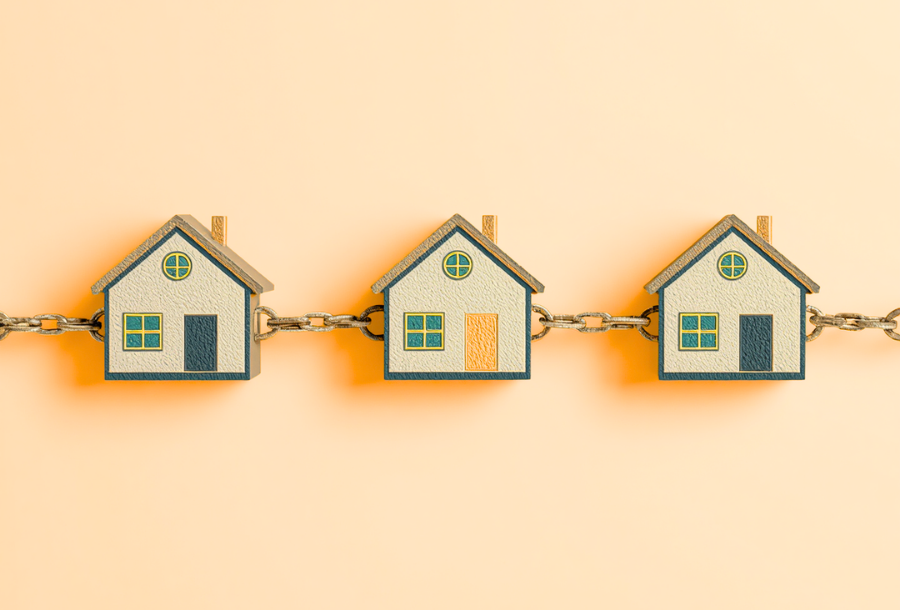
A property chain forms when multiple transactions are linked together. You need to sell your home before you can buy the next one. Your buyer needs to sell theirs. And so on. Each party depends on the other party completing at the same time.
Most UK chains involve three to four properties. A short chain of two or three properties typically completes in around four months. A long chain – five or more properties can stretch to six months or more, and that is when things start to unravel.
The phrase “long chain” matters because the risk is not evenly distributed. Every additional link multiplies the number of things that can go wrong. One mortgage refusal, one bad survey, one buyer who gets cold feet, and the whole structure comes down. You can be doing everything right and still lose your sale because of something happening four properties away from you.
According to The Negotiator’s 2025 report, the average time from agent instruction to completion is now 216 days. That is over seven months of exposure to everything that can go wrong in a long chain.
How Bad Is the Collapse Rate?
Worse than most people assume.
Data shows that 29.8% of residential property sales failed to complete in 2024. That figure has since edged down to 26% in 2025, but it remains far higher than comparable markets in Europe.
Perhaps more striking is what the GOTO Group’s 2025 report reveals: the UK fall-through rate almost doubled in just two years, rising from 16% in 2022 to nearly 30% in 2024. That is not a market blip. That is a structural problem.
The main reasons for sales collapsing in 2025, according to Quick Move Now:
- Buyers pulling out or changing their minds – 36% of all failed transactions
- Mortgage issues (refusals, valuation shortfalls, lender withdrawals) – 33%
- Survey problems leading to withdrawal or failed renegotiation – 18%
- Chain breaks – a separate category that compounds all of the above
Chain breaks are particularly punishing in a long chain because the domino effect travels in both directions. Whoever is in the middle bears the most risk.
A survey by Barclays found that 32% of people who bought or sold in the last three years were part of a chain, and nearly half of that group – 46% – experienced delays or a full breakdown. This is not a fringe experience. It is the standard experience.
What a Collapsed Chain Actually Costs
When a sale falls through, the money already spent does not come back.
Barclays’ research puts the average additional cost of a chain breakdown at £2,127. That covers wasted survey fees, extra solicitor time, and other sunk costs. But that figure underestimates the full picture.
The Negotiator’s report estimates the average cost to a buyer of a failed sale at £2,727, and calculated that approximately £3.05 billion was lost across the market between 2021 and 2024 from failed transactions alone. Agents are not immune either; the same report puts the average agency cost at £4,123 per fall-through, plus at least seven days of wasted staff time.
For sellers sitting in a long chain, each additional month brings additional costs: mortgage payments, insurance, potential storage fees if they have already partially moved, and the ongoing uncertainty of not knowing whether the deal will actually be completed. Those costs accumulate quietly in the background while everyone waits for the chain to move.
Why Sellers Are Increasingly Accepting Lower Cash Offers
When you have already watched one or two sales collapse at the last minute, your view of what a “good offer” looks like changes.
The shift is measurable. Research by Together Financial found that when a chain collapsed, 29% of sellers sought a chain-free buyer as their first move, and 17% specifically sought a cash buyer. Only 15% said they would try a quick-sale company. The preference is clear — sellers who have been burned by a long chain want certainty above all else.
Cash sales in the UK now account for around 22.4% of completed transactions, down from 28.6% in 2022, according to HMRC data analysed by MPowered Mortgages. As cash buyers have become relatively scarcer, their negotiating power has grown. They can, and do, use their chain-free status as leverage.
Stuart Cheetham, CEO of MPowered Mortgages, put it directly: “Buyers who have their finance fully in place when making an offer are vastly more proceedable than those who don’t. Sellers will often accept a lower offer in return for the extra certainty these buyers represent.”
That is the core of the deal being struck across the market right now. Sellers are not being naive. They are doing the maths, and in many cases, accepting a lower price from a genuine cash buyer is the rational decision.
How Much of a Discount Are Cash Buyers Getting?

The numbers vary by region, property type and the seller’s circumstances. But the range is significant.
MPowered Mortgages’ analysis found that cash buyers paid an average of £28,189 less than mortgage buyers on equivalent homes in 2025, roughly a 9.3% discount. Regional variation is wide:
- North West: cash buyers securing up to 13.4% below average price (£31,827 saving)
- Scotland: average discount of 12.8%
- North East: 12.4% below mortgage-buyer prices
- South East: discount of around 7.2%
- London: the exception – cash buyers in the capital have historically paid a small premium, reflecting high numbers of foreign investors, though that premium has narrowed significantly
Zoopla’s data for 2025 shows the overall negotiation gap between asking price and agreed sale price running at 3.5–4%, but this is the average across all buyer types. For sellers dealing with a problem property, a long chain, or urgent circumstances, the effective discount accepted is considerably higher.
Professional property buying companies – a distinct category from private cash buyers operate at a steeper discount still. Companies of this type typically offer 73–85% of the asking price, reflecting the speed of completion (often 7–28 days) and the guarantee that the sale will not fall through.
Whether a cash discount is worth accepting depends entirely on the seller’s situation. For someone with a clean property and no time pressure, holding out for a mortgaged buyer at full market value still makes sense. For someone stuck in a long chain that has already fallen through once, it is a very different calculation.
The Structural Problem Behind It All
The UK’s high fall-through rate is not just bad luck. The GOTO Group’s report identifies four root causes: no upfront funding commitment, no upfront property information, no upfront contractual obligation, and a conveyancing bottleneck.
In most other countries, buyers and sellers are bound contractually once an offer is accepted. In England and Wales, there is no obligation on either side until the exchange of contracts, which typically happens weeks or months into the process. Either party can walk away at any point, for any reason, with no financial penalty. This means a long chain can collapse at the last minute with no recourse.
Scotland operates differently under Scots Law, with binding missives replacing the lengthy pre-exchange period, which partly explains why the Scottish market sees fewer late-stage collapses.
The government has acknowledged the issue, but meaningful reform, whether reservation agreements, mandatory upfront property information packs, or a restructured transaction process, has moved slowly. The National Association of Property Buyers (NAPB) and other industry bodies have pushed for change, but buyers and sellers currently have no choice but to operate within the existing framework.
What This Means If You Are Selling
Understanding where you sit in the chain matters before you accept any offer.
Ask your estate agent, before you accept, how many properties are in the chain, who is at the top, and whether they are chain-free. A long chain with an unconfirmed buyer at the top is a much riskier proposition than a shorter chain with a first-time buyer or cash buyer at the head.
If you have already experienced one collapse and are back on the market, the maths on accepting a slightly lower cash offer shifts considerably. You have already absorbed the financial and emotional cost of a failed sale. A second round carries the same risks.
Practical steps that reduce chain-related risk:
- Prioritise proceedable buyers. A first-time buyer, a cash buyer, or someone who has already sold and is renting is always preferable to the highest offer from someone who still has to sell their own home.
- Instruct a proactive solicitor, not just a cheap one. According to The Intermediary, more chains collapse through communication delays than through genuine financial problems. A solicitor who chases weekly and flags issues early keeps things moving.
- Set a target exchange date early. Agree on it with all parties and work backwards from it. Without a shared deadline, everyone moves at their own pace, which usually means slowly.
- Consider temporary rental as a chain-breaking strategy. Selling first and renting temporarily turns you into a cash-equivalent buyer for your next purchase. You remove yourself as a vulnerability point in any long chain, and sellers of the property you want to buy will treat you very differently.
- Do not dismiss a cash offer on principle. Run the full numbers. Factor in the realistic timeline of a traditional sale, the probability of fall-through, holding costs, and agency fees. The gap between a cash offer and a mortgage buyer’s offer is often smaller than the headline figures suggest.
What This Means If You Are Investing
For cash investors, whether flipping or buying to let, the current environment is arguably the most favourable in recent years.
Sellers who have been through one or more chain collapses are motivated. They are not necessarily distressed, but they have recalibrated what a successful outcome looks like. Certainty and speed carry real monetary value for them, and they will discount accordingly.
The 9.3% average cash buyer discount (MPowered Mortgages, 2025) is a market-wide average. For specific situations — a property stuck on the market for months, a seller who has already lost two buyers, or a home that needs work and therefore sits outside mortgage lending criteria — the achievable discount is wider.
Understanding the distinction between a long chain situation and a straightforward sale is part of the due diligence. A seller accepting below-market value because they have been failed by a long chain is a very different situation from a seller accepting below-market value because the property has a structural problem. Know which one you are dealing with.
Membership of the National Association of Property Buyers (NAPB) and registration with The Property Ombudsman (TPO) are the minimum credentials to look for when dealing with professional cash buying operations, whether you are the buyer or you are referring sellers to one.
FAQs
Q1: Is a cash offer always below market value?
Not necessarily. Private cash buyers — individuals purchasing a home to live in — often pay close to market value. The larger discounts associated with cash buyers mainly apply to professional property buying companies offering guaranteed completions in days, or to properties that mortgage lenders will not touch (structural issues, very short leases, or uninhabitable conditions). For a standard property in decent condition, a private cash buyer might offer 5–10% below the asking price.
Q2: Can a seller legally pull out of a sale once they have accepted a cash offer?
Yes. In England and Wales, no transaction is legally binding until contracts are exchanged. This applies equally to cash sales and mortgage-dependent sales. The seller can withdraw at any point before exchange without financial penalty, and so can the buyer. This is one of the core structural weaknesses of the UK system and a key reason fall-through rates remain so high.
Q3: What does “chain-free” actually mean on a listing?
It means the seller is not dependent on purchasing another property to complete the sale. Common reasons include a probate sale (the owner has died), a property previously rented out, someone moving into rented accommodation, or a new build. Chain-free does not guarantee a fast sale — conveyancing timelines and buyer issues still apply, but it removes the long chain risk from the seller’s side entirely.
Q4: Does accepting a cash offer affect stamp duty for the buyer?
No. Stamp Duty Land Tax (SDLT) is calculated on the purchase price regardless of how the purchase is funded. A cash buyer pays the same stamp duty as a mortgage buyer on an equivalent property at the same price. The only saving from buying with cash is the absence of mortgage arrangement fees, broker fees, and lender valuation costs.
Q5: If my property chain collapses, can I claim back my solicitor’s fees?
Generally, no. Conveyancing fees are typically payable for work done regardless of whether the transaction completes, unless your solicitor operates a “no completion, no fee” arrangement – which some do offer. Survey fees are almost always non-refundable. This is why upfront costs mount quickly in a failed sale: it is not just one bill but several running simultaneously.
Q6: What is the National Association of Property Buyers (NAPB), and why does it matter?
The NAPB is a membership body for professional property buying companies. Members commit to a code of practice covering fair offers, transparency, and complaint handling. If you are considering selling to a cash-buying company or recommending one to a client, NAPB membership alongside The Property Ombudsman (TPO) registration is the clearest indicator of a legitimate operation. The cash-buying sector is not fully regulated, and the companies operating within it are not either.
Related articles